What is a DID? Direct inward dialing for call buyers and operators
A direct inward dial number, or DID, is a phone number your carrier delivers straight into a system you control. In an office, that system is the company's phone switch. In call tracking, it's the platform that routes your calls.
So your tracking numbers are DIDs. TrackDrive's provider page describes "a single interface for managing phone numbers (DIDs)".
This guide follows a DID through a pay-per-call campaign. It covers what the number carries, where it comes from, how the call reaches a buyer, and what SIP headers add.
What does DID mean?
DID stands for direct inward dialing, a service phone companies offer. A DID number, or DID phone number, is one number delivered through it. In Europe and Oceania, the same service is also called direct dial-in, or DDI.
A DID is a number, not a physical line. Many numbers can share a few connections into your system.
How does direct inward dialing work?
In an office, a company has a block of numbers and a few shared lines, called trunks. They run into its private branch exchange, or PBX: the switch that connects outside calls to desks.
When a call arrives, the carrier signals the dialed number to the PBX. The PBX can use it to ring the right extension.
A tracking platform does the same job for a different destination. TrackDrive's number overview calls numbers "the interface between the public phone network and the internal call routing pipeline".
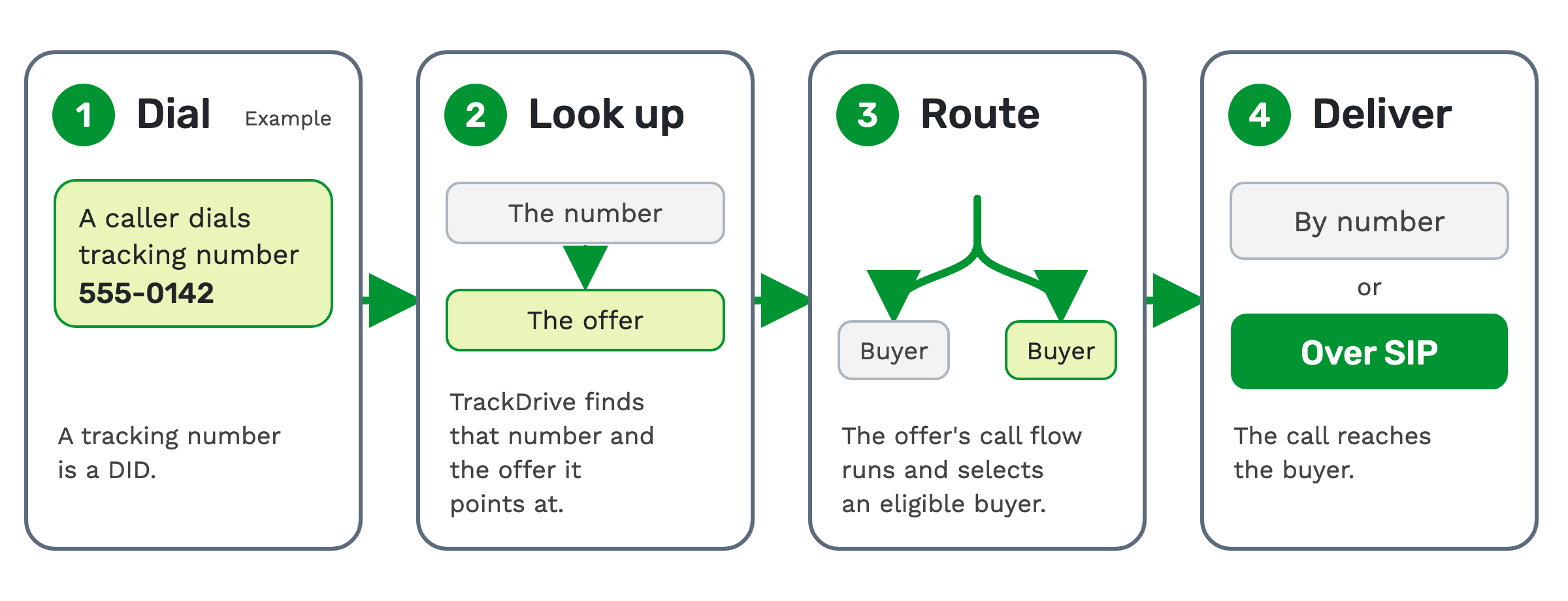
In outline, a call that finds a buyer on TrackDrive goes like this.
1. Dial. A caller dials a tracking number, which is a DID.
2. Look up. TrackDrive finds that number and the offer it points at. An offer is the campaign the call belongs to.
3. Route. The offer's call flow runs and selects an eligible buyer, if there is one. A buyer is the business that receives and pays for the call.
4. Deliver. The call reaches the buyer, commonly by number or over SIP.
Why the dialed number is your attribution
Start with an ordinary phone call. TrackDrive's help center says "the only identifier available the moment an inbound call rings is the dialed number itself". The platform uses it to find the owning company and route the call.
So the number has to carry the meaning. Episode 3 of the TrackDrive Pay-Per-Call Masterclass says "A tracking number is a phone number that belongs to one publisher and one campaign". A publisher is whoever sends you the calls.
If two publishers share a number, the episode warns, "you lose the ability to say who deserves the credit".
One offer can have many tracking numbers, and each can carry different attribution tokens. An attribution token is a key-value pair describing where a call came from, such as its traffic source.
Those tokens "persist on the contact, so repeat callers are attributed to their original source". For the full picture, read what is inbound call tracking.
Number pools: one DID per website visitor
One number on a web page can't tell one visitor from the next. A number pool can. It's a collection of tracking numbers that a page shows to visitors, one number per visitor session.
On TrackDrive, JavaScript fetches a number from the pool and swaps it onto the page. Each visitor session gets a different number, and the dialed number maps back to that session.
A number is re-used once its hold timeout expires, "but not while a session is live". So two sessions that are live at the same time can't share a number. Read dynamic number insertion, explained for how it's set up.
Where your DIDs come from
On TrackDrive you can buy numbers or import them from your own account. You can also connect your own carrier over SIP.
- Buy them. Provision new numbers from a connected provider, by country, area code and type. The types are local or toll-free. Pay-per-call numbers covers choosing between them.
- Bring your own account. Link your own Twilio, Plivo or Telnyx account and import its numbers in one click. Those are the three providers the help center lists for bringing your own carrier.
- Route your own carrier in over SIP. SIP, or Session Initiation Protocol, is a standard way to set up calls over the internet. TrackDrive connects your own VoIP infrastructure this way.
Numbers on a linked Plivo, Twilio or Telnyx account route through your own carrier relationship. The calls still run through TrackDrive's billing: they're billed per minute, each connected number has a monthly fee, and texts are billed too. TrackDrive still handles "the routing logic, the hold queue, and the call processing".
Getting the call to a buyer: by number or by SIP
Once a buyer is selected, the call usually reaches it in one of two ways.
By number. TrackDrive dials the buyer's own DID. TrackDrive's SIP routing article says the consumer's caller ID "is presented as the calling number".
The buyer's carrier then sees a number TrackDrive doesn't own. It applies the signing rules of STIR/SHAKEN, a way to sign a call so its caller ID can be checked.
The article says "Most providers sign these calls B-Level", meaning the carrier vouches for the originator but doesn't own the number. It adds that downstream carriers "increasingly treat B-Level traffic with suspicion": endless ringing, immediate voicemail or silent failures.
For more on how carriers treat calls, see why calls show Spam Likely.
By SIP. The article says sending a call SIP-to-SIP "avoids the public PSTN entirely and bypasses carrier reputation handling". The PSTN is the public switched telephone network, the ordinary phone system.
It calls SIP delivery "immune to most B-Level degradation patterns". That's most, not all.
A buyer on another call tracking platform with a published SIP endpoint is set up as an external platform record. The
endpoint must start with sip:, hold a placeholder for the number to dial, and contain @ followed by a domain or IP.
Calls can come in the same way. A traffic source, the record for whoever sends the calls, can SIP route in using the
address form sip:real_td_number@sip.trackdrive.com.
SIP headers: the data that travels with the call
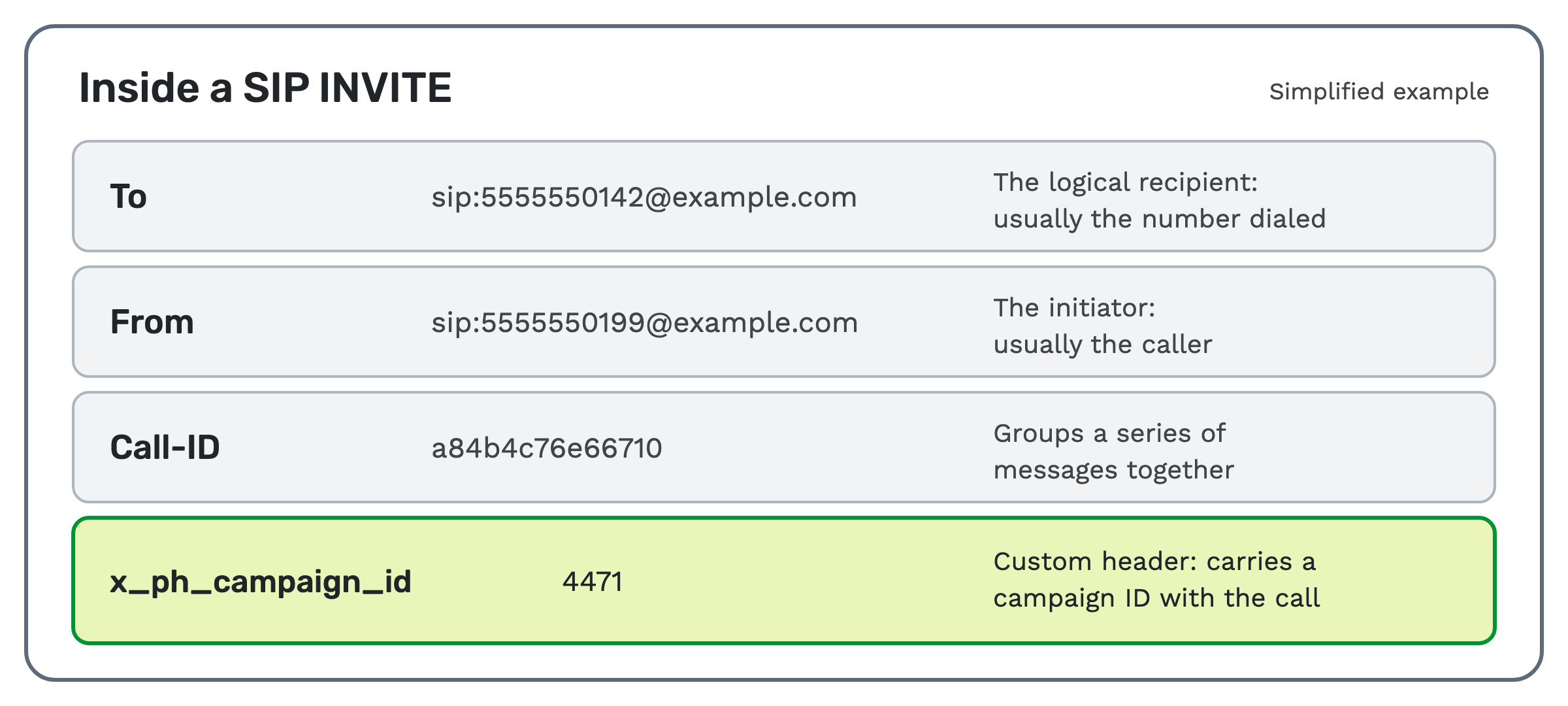
A SIP call starts with an INVITE, the request that "asks a server to establish a session" (RFC 3261, the SIP standard). A SIP header is a named line of data inside that request.
The standard headers: To, From, Call-ID
- The SIP To header "specifies the logical recipient of the request". On a phone call, that's usually the number dialed.
- From "indicates the logical identity of the initiator of the request". That's usually the caller.
- Call-ID "acts as a unique identifier to group together a series of messages".
Custom headers: a tracking link for a call
A sender can also add headers of its own. The standard tells a receiving system to ignore a header it doesn't understand, so an extra header shouldn't stop the call.
A custom header can carry a campaign ID or a publisher ID along with the call, much as a tracking link carries its parameters. It only helps if the system on the other end is set up to read it.
What TrackDrive's documentation says
TrackDrive's SIP support page says you can "add any number of headers to enable feature toggles or meet provider-specific requirements". Its API reference describes two more things.
Reading headers on inbound calls. SIP Header Parsing is "A named set of rules that pull data out of SIP call headers and save it to a lead". Each group "is attached to one or more offers".
A single rule, a SIP Key, "maps one SIP header to a contact
field". The reference's example maps x_ph_campaign_id to campaign_id.
Sending headers to a buyer. Custom SIP headers are "key/value pairs Trackdrive sends to a buyer over SIP trunking when it connects a call". Each one is tied to a specific buyer.
What a DID costs on TrackDrive
On TrackDrive-supplied numbers, each number has a monthly rate and inbound calls are billed per minute. Billing rounds up to the full minute, with separate rates for local and toll-free numbers.
That rate includes forwarding the call to your buyer over toll-free or SIP; international and premium rate centers can add cost. Forwarding to a buyer's local number costs more.
There's no onboarding fee. See TrackDrive pricing for current rates and commit plans.
Questions people ask
What is DID in telecom, and how is it different from DOD? DID brings calls in from the outside network. Direct outward dialing, or DOD, is the matching outgoing service.
Is a DID the same as a toll-free number? Not quite. DID describes how a number reaches your system, and toll-free describes the number. TrackDrive sorts its numbers as toll-free or local, with no further distinction between mobile, landline and VoIP.
Is a DID the same as call forwarding? No. A DID is the number a call arrives on. Forwarding sends that call somewhere else, such as a buyer. A tracked call uses both.
How many DIDs does a call business need? One for each publisher and campaign you want to tell apart. Add a number pool if website visitors need their own numbers.
Can I keep numbers I already own? If they're on your own Twilio, Plivo or Telnyx account, link it and import them in one click.
See it in action
Request a demo for a live walkthrough tailored to your use case, or start free, with no credit card and no onboarding fee.